▸ Biotech IP diligence
Scientific clarity before biotech licensing and investment decisions.
Fyled supports investors, licensing teams, biotech companies, and counsel with scientific analysis of patent portfolios, technical overlap, implementation dependencies, and claim-relevant positioning.
We help transaction teams understand what a portfolio appears to control, where external dependencies may sit, and whether the technical position supports differentiation, leverage, or future exposure.
Discuss a Diligence Matter▸ Why Fyled diligence is different
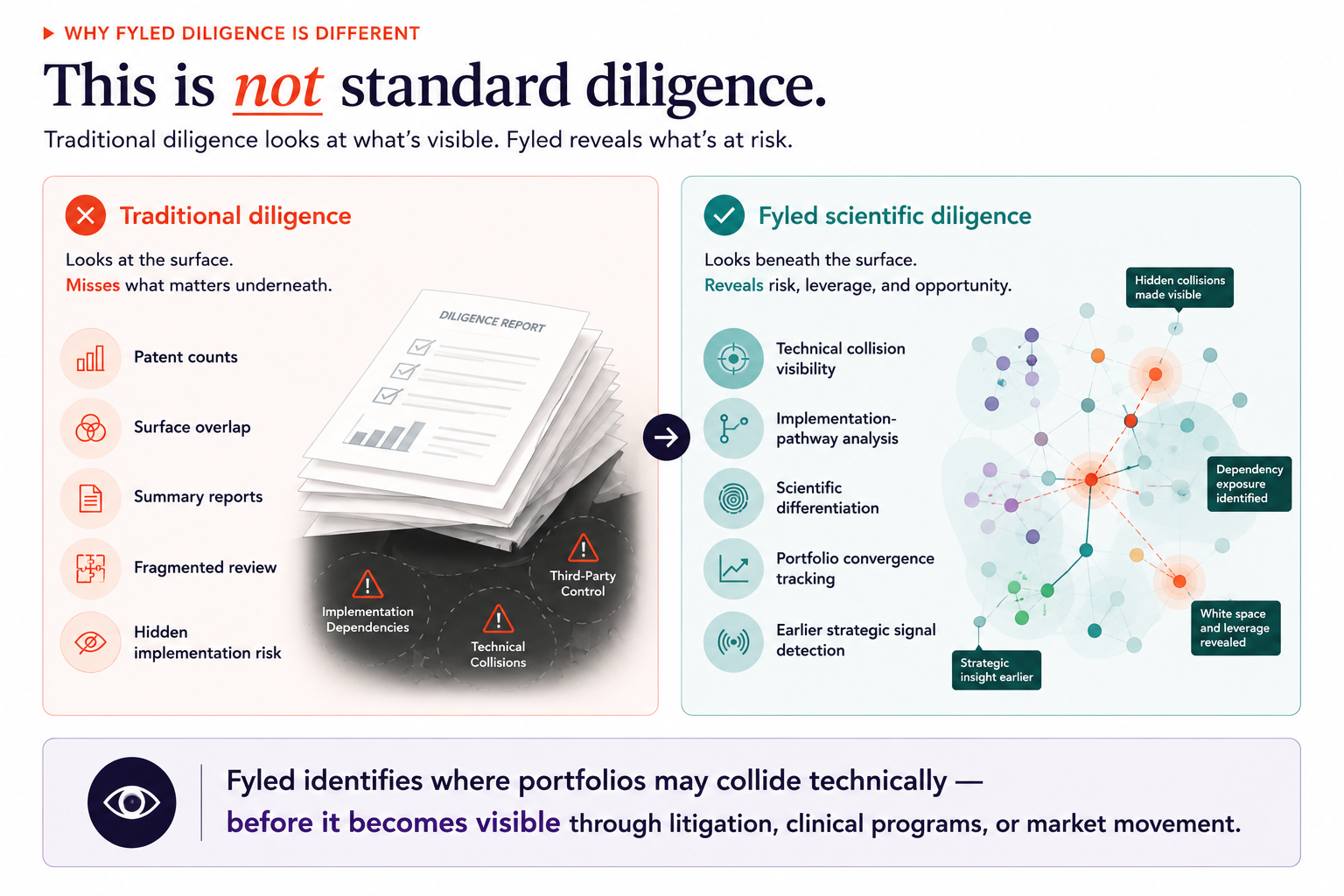
Standard diligence can miss the scientific risks underneath the portfolio.
Fyled looks below patent counts and surface summaries to identify technical dependencies, hidden collisions, implementation risk, and strategic leverage before they become expensive.
▸ Why this matters
Scientific differentiation and implementation independence are not always the same thing.
A biotech portfolio may look differentiated at the headline level while still depending on external delivery systems, constructs, manufacturing steps, enabling components, or indication-specific implementation paths.
Fyled helps transaction teams evaluate the scientific substrate underneath the IP position so diligence can move beyond patent counts, summaries, and surface-level landscape review.
Diligence questions this helps answer:
- What does the portfolio appear to control technically?
- Where are the key implementation dependencies?
- Which external owners may matter for licensing or partnership?
- Is the asset differentiated, crowded, or exposed?
- Where does the scientific value of the portfolio actually sit?
▸ What Fyled evaluates
Investment-grade scientific interpretation of biotech IP positions.
Portfolio differentiation
Assess whether the portfolio is technically distinct from surrounding competitors or clustered in crowded territory.
Implementation dependencies
Identify external components, delivery systems, processes, constructs, or enabling technologies that may affect implementation.
Technical overlap
Map where claims, mechanisms, sequences, constructs, delivery systems, or indications overlap with the surrounding landscape.
Licensing relevance
Separate potential component owners from direct competitors, background noise, and platform-adjacent players.
Technical differentiation
Evaluate where the scientific architecture appears differentiated, concentrated, dependent, or exposed across the surrounding landscape.
Strategic exposure
Identify where portfolio value, competitive pressure, or transaction risk may concentrate.
▸ Example outputs
Present-state views of ownership, dependency, overlap, and portfolio leverage.
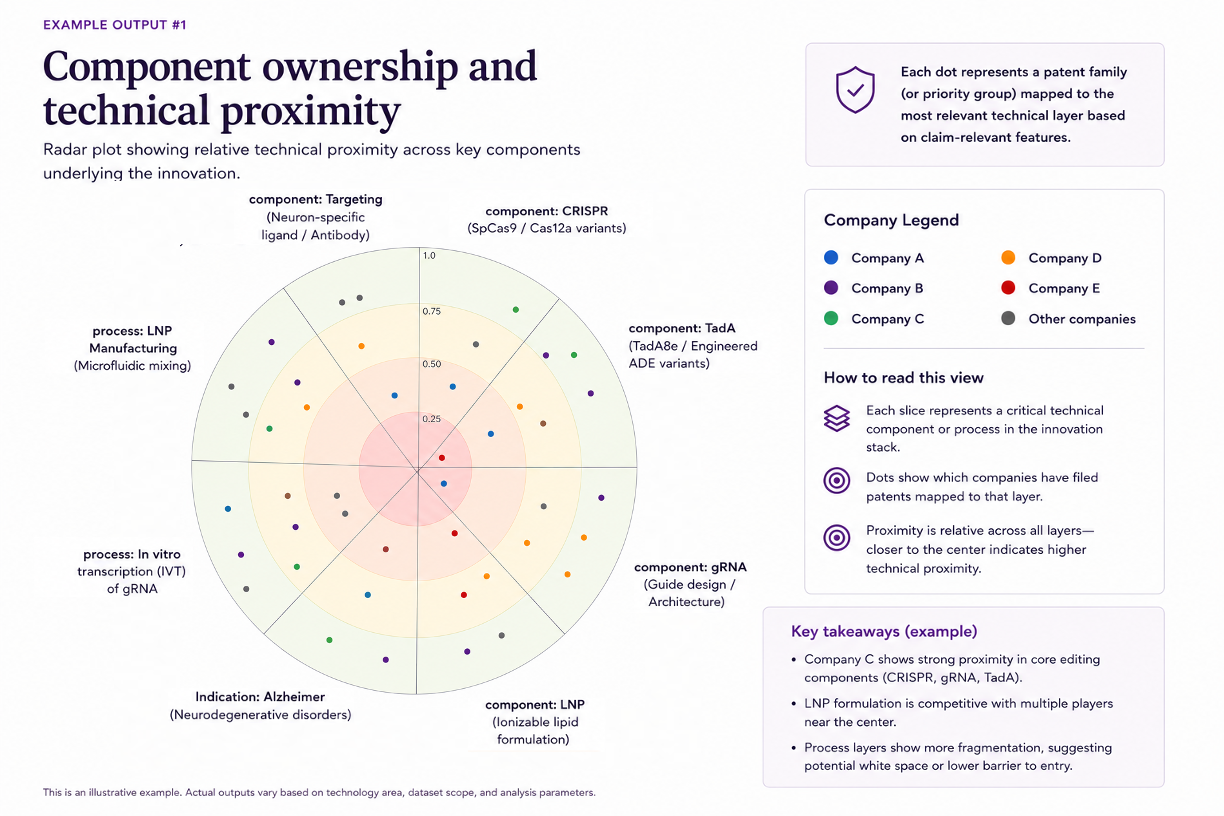
Component ownership and technical concentration
Map which companies hold patent concentration across the critical scientific components underlying the innovation, helping diligence teams see where control, dependency, and external ownership may sit.
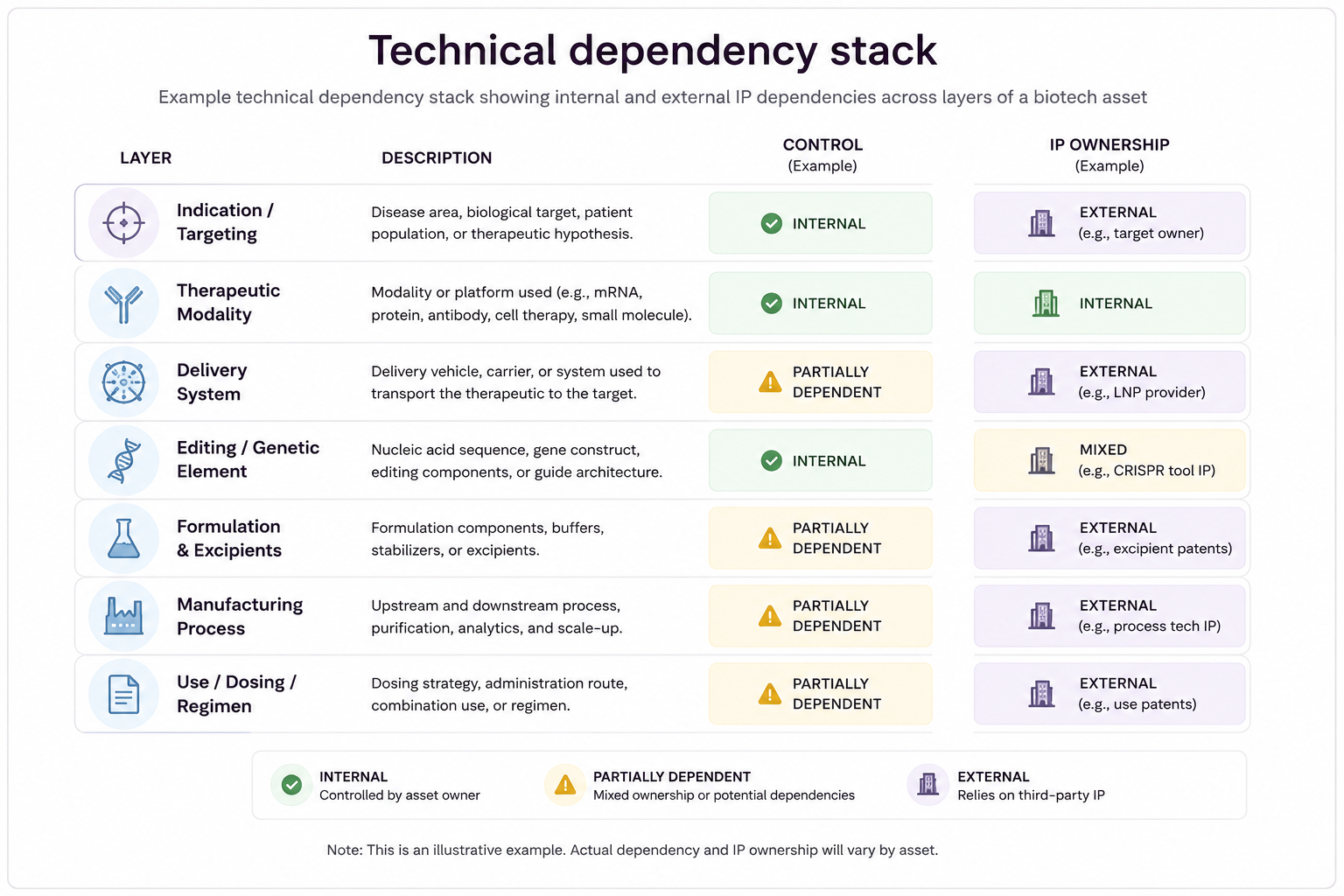
Technical dependency stack
Break the asset into core technical layers — such as delivery, editing system, guide architecture, formulation, manufacturing, targeting, or indication — to identify which layers are controlled internally and which may depend on external IP.
Technical dependency and implementation landscape
Compare companies across scientific and implementation domains to identify external dependencies, platform concentration, implementation complexity, technical overlap, and areas where control or exposure may concentrate across the innovation stack.
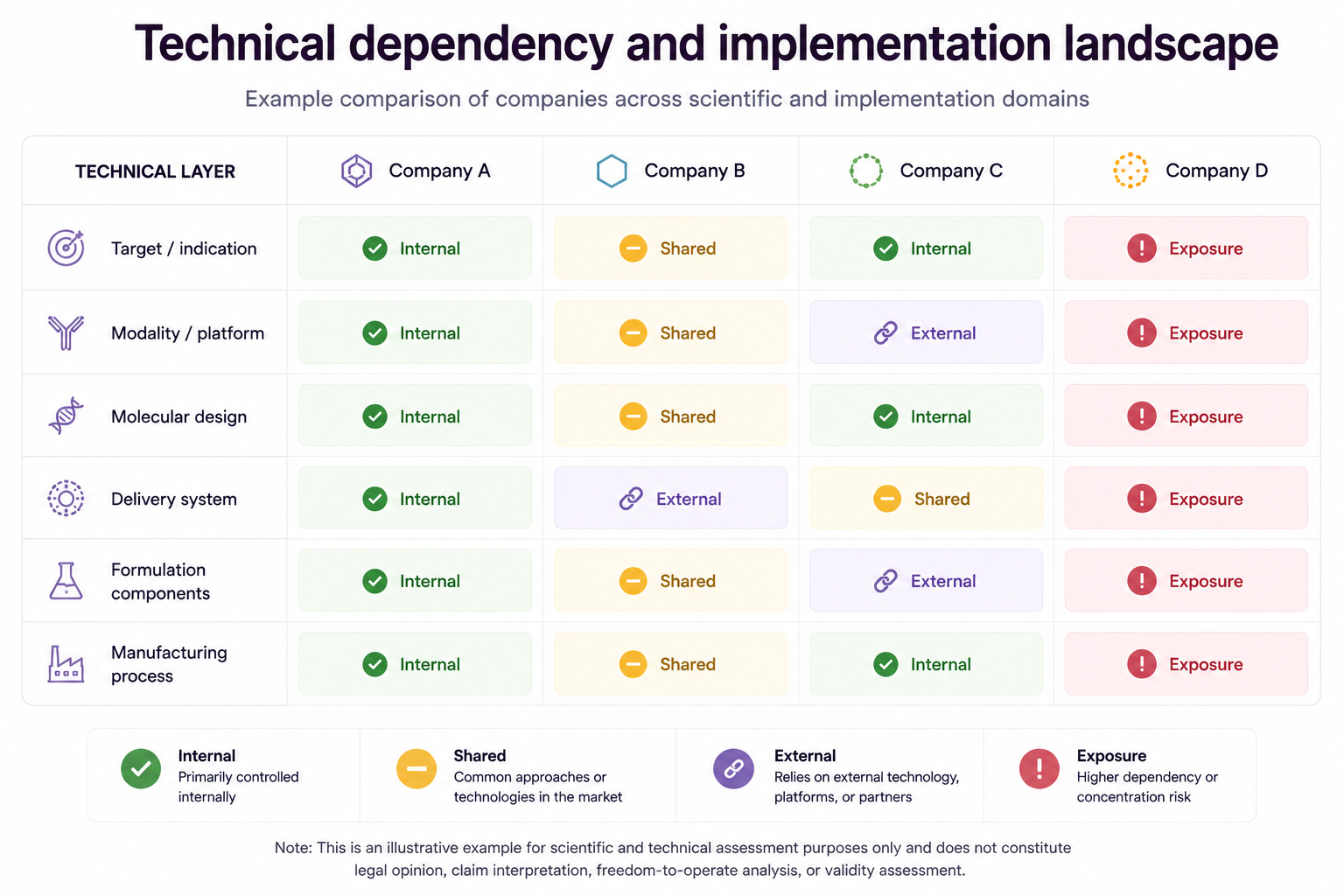
This visualization is intended for scientific and technical positioning purposes only and does not constitute legal opinion, claim interpretation, freedom-to-operate analysis, or validity assessment.
▸ Transaction use cases
Support licensing, investment, and partnership decisions with structured scientific diligence.
Investors
Assess whether technical differentiation is durable, exposed, implementable, or converging toward crowded territory.
Licensing teams
Identify which companies control enabling components versus which players represent direct technical overlap.
Biotech companies
Understand portfolio leverage, technical dependencies, and areas where additional patent positioning may matter.
Counsel
Support transaction-related analysis with a structured scientific foundation and attorney-directed follow-up.
▸ How Fyled supports diligence
Scientific diligence that moves from portfolio structure to transaction-relevant interpretation.
Clarify the product, platform, indication, modality, and implementation pathway.
Separate the asset into relevant technical layers, components, mechanisms, and dependencies.
Identify technically relevant patents, owners, claim-facing features, and scientific overlap.
Assess differentiation, dependency, licensing relevance, crowding, and technical defensibility.
Answer attorney-, investor-, or transaction-directed questions as the diligence scope narrows.
Fyled provides scientific and technical analysis of biotech patent landscapes, implementation pathways, portfolio structure, and technical overlap. Fyled does not provide legal opinions, claim construction, freedom-to-operate conclusions, validity opinions, or legal determinations outside attorney-directed workflows.
Evaluate the science underneath the transaction.
Most diligence engagements begin with a portfolio, asset, technology area, license target, investment question, or transaction-specific technical concern.
Discuss a Diligence Matter Fyled | Biotech Technical Analysis for IP Attorneys