
Biotech patent landscape strategy
Understand where a biotech space is converging — and where it is not.
Fyled builds structured scientific and patent landscapes that help attorneys, companies, and investors understand technical overlap, competitive positioning, licensing pressure, and strategic whitespace across complex biotech fields.
Why this is different
This is not standard patent landscape work.
Traditional patent landscapes often produce lists, owners, and broad categorizations. Fyled focuses on scientific positioning: how patent families, technologies, mechanisms, and companies relate to the actual innovation and how that relationship changes over time.

🔍 Click image to enlarge
For the broader Fyled thesis, see Biotech Patent Intelligence: why biotech IP decisions increasingly depend on scientific interpretation rather than document review alone.
Why this matters strategically
Patent activity can reveal strategic direction before it becomes obvious elsewhere.
In complex biotech markets, patents are often among the earliest visible signals of where a company is technically capable of moving next. Scientific convergence can appear in the IP layer before clinical programs, partnerships, publications, or public positioning fully emerge.
Fyled helps teams understand:
- where competitive convergence is increasing
- where technical whitespace still exists
- which capabilities are expanding inside competitor portfolios
- where licensing, overlap, or future collision risk may emerge
- how a landscape evolves over time — not just where it stands today
Strategic use cases
Patent landscapes become more useful when they show direction, pressure, and positioning.
Licensing strategy
Identify where technical overlap may require licensing, collaboration, or defensive positioning.
Competitive behavior
Track whether competitors are moving toward, away from, or parallel to a scientific position.
Whitespace discovery
Find underdeveloped technical directions with lower crowding and stronger differentiation potential.
Convergence risk
Understand where companies, claims, and technical approaches are beginning to converge.
Portfolio evolution
Model how patent positions develop over time and whether proximity to the innovation is increasing.
Strategic diligence
Support investor, licensing, and internal strategy decisions with structured technical positioning.
Example outputs
Visual strategy tools for complex biotech patent landscapes.
Fyled translates complex patent and scientific information into visual tools that clarify where overlap, crowding, differentiation, and strategic risk may concentrate.
Proximity mapping across competitive patent landscapes
Patent families are positioned by estimated technical proximity to the innovation, helping attorneys identify where overlap, differentiation, and strategic risk may concentrate across competing companies.

🔍 Click image to enlarge
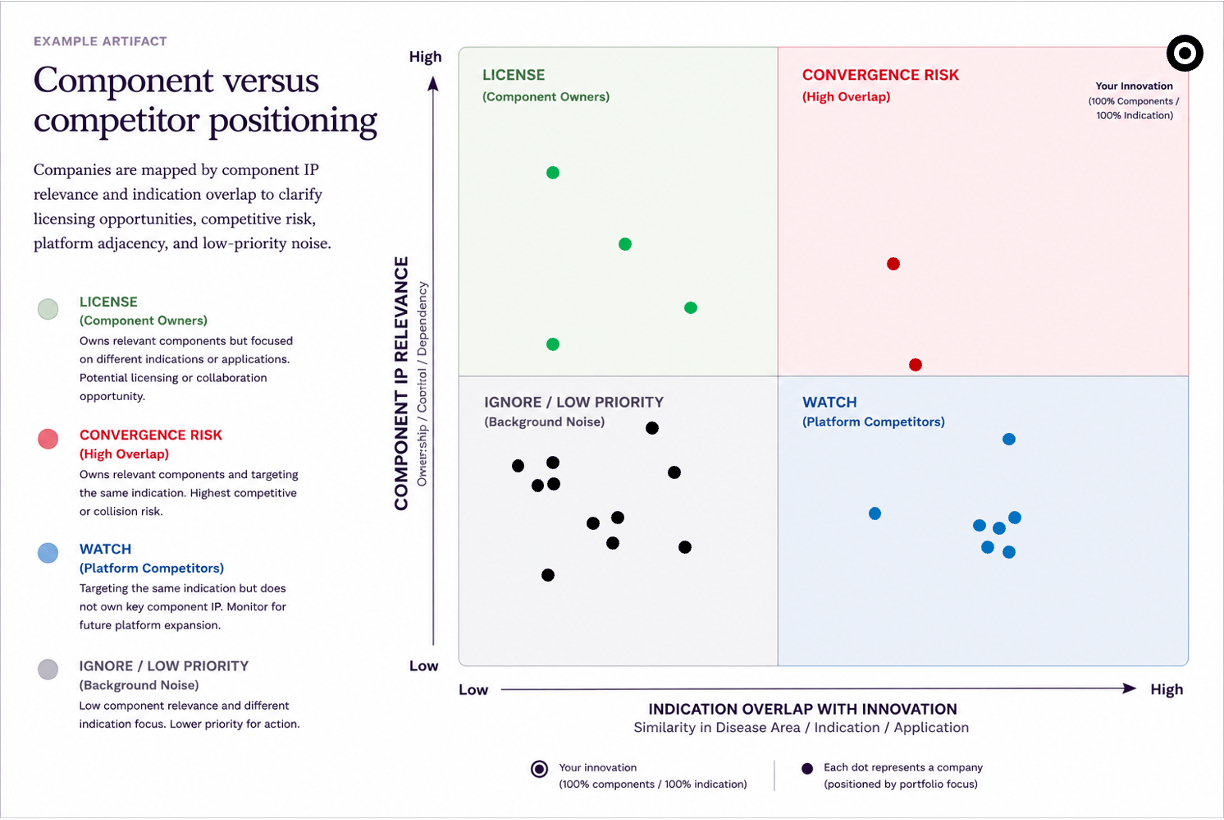
Component versus competitor positioning
Separate license-relevant component owners from direct convergence risk, background noise, and platform competitors.
🔍 Click image to enlarge
IP crowding and escape-route analysis
Identify which technical steps are crowded and where alternative routes may provide stronger differentiation or lower patent density.

🔍 Click image to enlarge
Portfolio evolution over time
Track whether a competitor’s patent portfolio is moving closer to, away from, or parallel to the innovation as new filings emerge.

🔍 Click image to enlarge
Landscape intelligence across technology areas
Different biotech modalities create different landscape signals.
In biotech, patent landscapes become more useful when they show scientific direction, not just document volume. Competitive convergence, whitespace, licensing pressure, and portfolio evolution may appear differently across chemistry, biologics, genetic medicine, cell systems, radiopharmaceuticals, and AI-native discovery.
Chemistry and modality systems
Biology and genetic medicine
Related Fyled services
How Fyled models the landscape
Structured scientific modeling, not just patent search.
Define the innovation, technical layers, and relevant biological systems.
Translate claims into comparable scientific and technical features.
Model technical closeness across patent families, companies, and mechanisms.
Identify convergence, crowding, whitespace, and licensing pressure.
Update the landscape as attorney questions or strategic priorities evolve.
Who uses this
IP law firms
Claim-aware landscape interpretation, licensing pressure, competitive movement, and attorney-directed strategic support.
Biotech companies
Pipeline differentiation, competitive positioning, whitespace evaluation, and future patent strategy support.
Investors and diligence teams
Technical overlap, platform convergence, ownership concentration, and strategic exposure mapping.
Explore a biotech landscape strategically.
Most engagements begin with a technology area, patent set, platform hypothesis, competitive question, or strategic positioning problem.